
.webp?v=639247041873369369)

 Monday, 09/09/2026 - 12:00
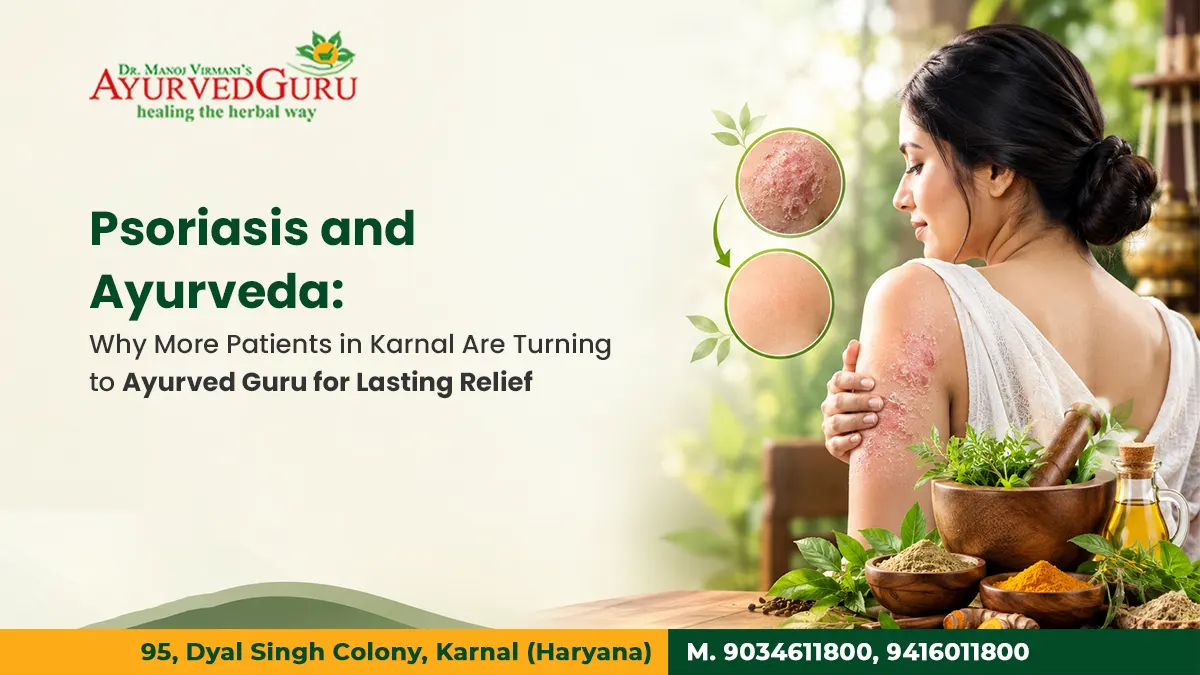
If you've ever dealt with psoriasis, you know it wears you down in more ways than one. The plaques flare up, calm down, then come back again. The itching keeps you up at night. And honestly, the emotional weight of visible skin flare-ups often outlasts the flare-up itself. For a lot of patients in Karnal and across Haryana, years of creams, steroid ointments, and repeat prescriptions have settled into a pattern that's hard to break: things get better for a while, then relapse. It's this exact frustration that's pushed more people toward psoriasis treatment without steroids, and it's part of why clinics working in classical Ayurveda — like Ayurved Guru in Karnal — are seeing more patients come through the door looking for something different.
What's Actually Happening Beneath the Skin
Psoriasis is a chronic autoimmune condition where skin cells regenerate much faster than they're supposed to, which is what produces those thick, scaly patches on the elbows, knees, scalp, and lower back. Modern dermatology usually manages it with topical steroids, phototherapy, or systemic immunosuppressants — and these can work, at least for a while. But a good number of patients eventually start looking for something that doesn't involve steroids long-term, mostly because of what prolonged use can bring: thinning skin, rebound flares, and a kind of dependency that creeps in over time.
Ayurveda looks at the whole thing differently. In the classical texts, psoriasis falls under a broader category called Kushtha — generally understood as an imbalance rooted in the Vata and Kapha doshas, often worsened by Pitta-driven inflammation and a buildup of Ama (toxins) in the deeper tissues. Instead of treating psoriasis as just a skin issue, Ayurveda treats it as a symptom of something going on deeper — usually tied to digestion, metabolism, and how the immune system is functioning.
How Ayurved Guru Approaches It
Ayurved Guru is based in Dayal Singh Colony, Karnal, and is run by Dr. Manoj Virmani, a BAMS-qualified Ayurveda practitioner with decades of clinical experience behind him, including years at Panchkarma Chikitsalyam. His work hasn't stayed confined to the clinic, either — he's received the Pride of Karnal award for his contribution to medical services in the region, and he's served as President of Arogya Bharati, Haryana State. It's the kind of track record that reflects a long-term commitment to traditional healthcare being accessible to the community, not just a credential on a wall.
At the clinic, the approach to psoriasis and other chronic skin conditions starts with figuring out what's actually causing the imbalance rather than just treating what's visible. That usually means a fairly thorough look at the patient's dosha constitution, their digestive strength (Agni), and their day-to-day habits — diet, sleep, stress, all of it — since Ayurveda ties skin health closely to digestion. From there, treatment tends to combine herbal formulations, external applications, and changes to daily routine, all aimed at gradually calming inflammation and helping the body detoxify on its own.
Why Patients Want a Root-Cause Fix, Not Another Temporary One
Ask patients why they're exploring permanent psoriasis treatment in Ayurveda, and the answer usually comes down to being tired of the same cycle — quick relief, then a return of symptoms, sometimes worse than before, once the medication stops. Ayurveda takes a different starting point: the idea that real, lasting improvement means dealing with what's happening internally — digestive imbalances, built-up toxins, doshic disturbances — rather than just quieting the skin from the outside.
At Ayurved Guru, that generally plays out as personalized herbal formulations meant to support internal detox, paired with external therapies to calm inflamed skin and cut down on scaling, without steroid-based creams in the mix. Diet gets a lot of attention too, since certain food combinations are believed to aggravate Kapha and Pitta and can make flare-ups worse. Most patients end up working through fairly structured lifestyle changes alongside their treatment — a reminder that, in this framework, managing psoriasis isn't only about what goes on the skin, but what's going on inside the body.
The Worry About Long-Term Side Effects
A lot of psoriasis patients eventually start worrying about what their medication is doing to them over the long run. Prolonged steroid use has been linked to thinning skin, discoloration, and something called rebound flaring, where symptoms come back worse once treatment stops. That's led plenty of people to look for a psoriasis approach without side effects — something that helps the skin without adding new problems on top of it.
Ayurvedic treatment at clinics such as Ayurved Guru usually leans on natural herbal ingredients, dietary correction, and traditional detox methods like Panchakarma. These work more slowly and gently than most conventional options — it's not an instant fix, and results genuinely vary from person to person depending on how severe and how long-standing the condition is. Still, many patients say this slower process feels easier on their body overall than staying on steroids indefinitely.
What a First Visit Actually Looks Like
Walking into Ayurved Guru for the first time usually means a fairly detailed consultation — medical history, current symptoms, a dosha assessment, and a conversation about lifestyle. Since psoriasis shows up differently for almost everyone — different locations, different severity, different triggers — treatment plans aren't one-size-fits-all. Follow-up visits let the plan get adjusted as the skin (and the person) respond over time, which is really the core of how Ayurvedic care works.
Patients are also expected to take an active role in their own recovery — sticking to dietary guidance, managing stress, and following the prescribed routine consistently. In Ayurveda, lifestyle alignment carries about as much weight as the herbal treatment itself.
Looking at the Whole Picture
Psoriasis is rarely just about the skin, and for a lot of people, the search for relief eventually leads somewhere that looks at the bigger picture instead of just the visible symptoms. With decades of clinical experience behind it and a solid reputation in the Karnal community, Ayurved Guru offers a structured, traditional path for managing psoriasis without leaning on steroids. If you're tired of short-term fixes and want to look into something more focused on the root cause, it might be worth having a conversation with an experienced Ayurvedic practitioner.


